

Sprunki Rejoyed
Sprunki Rejoyed
Related Games
More Games













Sprunki Rejoyed
What is Sprunki Rejoyed?
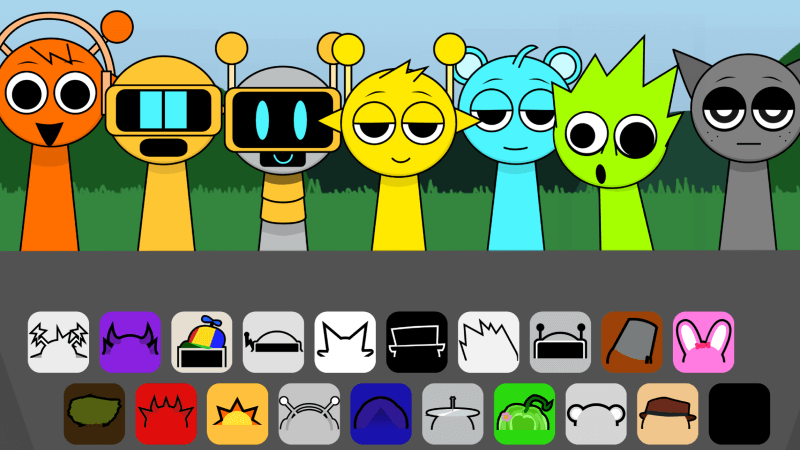
Sprunki Rejoyed opens on a row of gray figures with a palette of faces underneath. The gray figures are empty places in a musical arrangement, not characters you steer around a level. Give a figure a tile and it becomes a performer with a repeating part. The first interesting decision is not whether to fill the whole row but which sound should take up space. An opening part that feels thin on its own can be useful once it leaves room for a second part to answer it.
The daytime arrangement in Sprunki Rejoyed has a bright hillside behind the cast and enough room for seven sounds at once. The tile art is also a way to find your way back to a part: notice whether a face is in the upper or lower row, then remember its outline as well as its color. Look up at the performer after placing it. That change in the cast is a better confirmation of a successful drop than the pointer position, especially while you are learning which section of the figure accepts a tile.
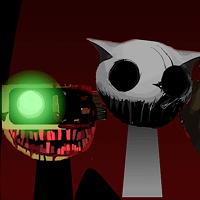
This browser edition is the unofficial Scratch port credited in the opening screen to personaNormal88889. Sprunki Rejoyed also has darker content beyond the daytime mix. If you prefer the bright presentation, stay with the initial lineup and the colorful tiles you have already tried. You do not have to reach another mode or finish a challenge for the arrangement to count. This is primarily a place to make and remake a short piece by ear.

What you control in Sprunki Rejoyed
- You decide the density of the mix. Leave most of the figures gray if a single pulse and another part are enough. An open slot is a spare place to compare a sound, not a mistake. Try using three slots for one arrangement and seven for another, then listen to which version makes the first part easier to hear.
- Sprunki Rejoyed gives a visual result as well as an audible one. After a good drop, the assigned figure adopts a different look and moves with its part. Try focusing on the center of the stage for a moment instead of watching the next tile you want to pick. You may notice the relationship between the sounds more clearly without changing anything.
- The two rows let you build a compact map of sounds in your head. Rather than remembering every name, pick an easy landmark such as the orange face near the left edge. Note the tile beside it and a contrasting tile on the lower row. Those landmarks make it easier to reconstruct a small test arrangement and avoid accidentally testing the same choice twice.
- The circular arrow at the upper right lets you start over. In Sprunki Rejoyed, clearing a crowded lineup can be more useful than piling on a final sound. Listen to the empty stage after the reset, then pick a different first tile. The contrast makes it easier to hear what the last arrangement was doing and which element you actually want back.
How to play Sprunki Rejoyed
- Click the green flag when it appears in the player. The opening message is part of the game, so seeing it after the flag does not mean the game is still downloading. Hold Space briefly while that message is on screen. Do not click the message itself. Wait for the hillside and the rows of icons to come into view before you begin dragging.
- Start Sprunki Rejoyed by picking a face tile from the top row and holding the pointer down. Carry it into the body of one of the gray figures and let go. Watch the figure change before you pick another icon. If the target looks unchanged, grab the tile again and drop it nearer the middle of the figure instead of along the edge.
- Choose a second tile for a different gray performer. Give the arrangement a little time to settle before changing it. Listen to whether the new sound fills a gap, competes with the first part, or makes the mix easier to follow. Keep the volume modest and try an alternative with a different tone rather than simply adding a third and fourth part immediately.
- Reset the lineup with the circular arrow when your comparison is finished. Try starting the next mix with the second sound you liked instead of repeating the old order. If you want to rebuild a mixture later, remember the positions of the tiles you used rather than assuming the player will save the lineup. A two or three part test is quick to reconstruct.