Rolling Balls Sea Race
Rolling Balls Sea Race
Rolling Balls Sea Race
What is Rolling Balls Sea Race?
Rolling Balls Sea Race is a casual physics racing game that propels you through breathtaking seaside routes where speed and precision determine victory. This competitive racing experience combines realistic ball physics with scenic ocean environments, offering both single-player challenges and multiplayer 2-player racing modes.
Control your ball through winding coastal tracks filled with jumps, turns, and obstacles. The physics-based gameplay creates authentic rolling momentum—speed, gravity, and surface friction all impact your ball's trajectory. Navigate sharp corners, time jumps across gaps, and maintain balance on narrow pathways while racing toward the finish line.
Collect coins scattered throughout each race to unlock a diverse roster of new balls with unique visual designs. Whether competing against friends in 2-player mode or mastering solo courses, every race tests your ability to balance speed with control. Push your ball to maximum velocity while avoiding crashes that cost precious seconds.
The game's stunning sea-themed environments feature vibrant colors, dynamic lighting, and realistic water effects that create an immersive racing atmosphere. Compete for the fastest times, challenge friends to head-to-head duels, and perfect your racing lines through increasingly complex track layouts with creative obstacle placement.
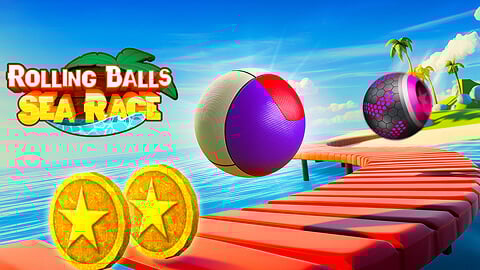
What Makes Rolling Balls Sea Race Special
- Multiplayer Racing: Compete head-to-head with friends in exciting 2-player split-screen races or challenge solo time trials.
- Physics-Driven Gameplay: Realistic ball physics with momentum, gravity, and friction create authentic rolling mechanics that reward skillful control.
- Scenic Ocean Environments: Race through beautifully designed seaside courses with vibrant visuals, water effects, and dynamic lighting.
- Unlockable Ball Collection: Collect coins during races to unlock new balls with diverse visual styles and unique designs.
- Competitive Leaderboards: Track your best times and compete against players worldwide for the fastest completion records.
- Varied Track Design: Navigate diverse course layouts featuring jumps, tight turns, narrow bridges, and creative obstacle configurations.
How to Play Rolling Balls Sea Race
- Choose Game Mode: Select single-player time trial for solo practice or 2-player mode to race against a friend on split-screen.
- Control Your Ball: Use arrow keys or controls to steer left and right—smooth inputs maintain stability at high speeds.
- Collect Coins: Gather coins scattered along the track to earn currency for unlocking new ball designs and customization options.
- Navigate Obstacles: Avoid barriers, gaps, and hazards that slow you down or end your run—maintain speed while staying safe.
- Balance Speed and Control: Push for maximum velocity on straight sections, then brake slightly before sharp turns to prevent overshooting.
- Cross Finish Line: Complete the course faster than your opponent in multiplayer, or beat your personal best time in solo mode.
Editorial Review: Momentum Matters More Than Maximum Speed
Rolling Balls Sea Race is most enjoyable when the course is read as a sequence of setup zones and commitment zones. A setup zone gives enough width to align the ball; a commitment zone is a bridge, jump, or sharp turn where large corrections become dangerous. Players who accelerate everywhere often arrive at the difficult section with the wrong angle. A slightly slower approach preserves control and usually produces a faster complete run because it avoids falls and restarts.
Our verdict is that the game suits players who like short physics challenges and visible improvement. The controls are easy to understand, yet clean runs require measured steering. The ocean setting keeps the course readable by contrasting track edges with open water, though the visual drop can make mistakes feel more dramatic. The two-player option adds immediate competition, while solo play is better for learning lines and testing whether a risky shortcut is actually faster.
- Best for short time trials, local competition, and players who enjoy momentum-based controls.
- A completed controlled run is more valuable than a fast opening followed by repeated falls.
- Practice course sections in solo mode before treating coin routes as racing lines.
Cornering Technique for Narrow Tracks
Enter a corner from the outside edge, make one smooth steering input toward the apex, and release before the exit. Holding the turn for too long continues to rotate the ball after it is already pointed down the next section. On a wide platform this costs a little time; on a narrow bridge it can cause an immediate fall. Watch the direction of travel rather than the ball's decorative rotation, because the texture can make speed look higher or lower than it really is.
Use small correction taps on straights. Alternating hard left and right creates a wobble that grows with speed, leaving little time to center the ball before a jump. If a landing begins off-center, reduce acceleration and stabilize first instead of forcing a sharp return to the ideal line. The safest recovery line may be slower for a second, but it preserves the run. Consistency improves when steering decisions are made before obstacles rather than while passing them.
Jumps, Landings, and Route Choice
For jumps, alignment is more important than a last-second burst of speed. Center the ball early, keep the input steady on the ramp, and avoid steering while airborne unless the game clearly gives enough control to correct. Plan the landing by looking beyond the gap to the next turn. A landing near the center is often preferable to collecting a coin at the edge, especially when another obstacle follows immediately.
Coins create a useful risk decision rather than an automatic objective. During the first course attempts, ignore pickups that require a major detour and learn the finish route. On later runs, add one coin line at a time and compare the result. A route is only better if it can be repeated. In two-player races, let the opponent take an unstable edge line if your central route is reliable; pressure often causes more lost time than the nominal shortcut saves.
A Practice Plan for Faster, Cleaner Runs
Divide practice into three goals. First, complete the course without falling, even if that means slowing before every narrow section. Second, identify two places where speed can be carried safely through a corner or onto a ramp. Third, choose one risky section to optimize while keeping the rest of the route conservative. This isolates the cause of improvement. Changing the entire route at once makes it difficult to know which decision saved time.
Use a reset rule to prevent rushed attempts: after two early falls, take one slow run focused only on alignment. In local two-player mode, agree on whether coin collection matters before the race starts so both players are competing under the same objective. The embedded build is the authority for current controls and available modes because browser versions can change. If a control label differs from this guide, follow the in-game prompt and send Sprunky.gg the page URL so the editorial note can be corrected.